Boosting Efficiency with WIP Aging Insights and Tools
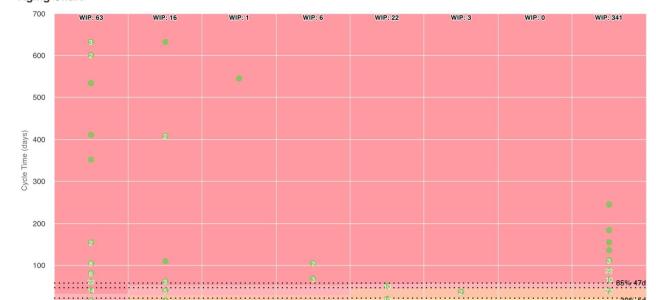
all red

When examining real workflow data, there's a common pattern: clusters of tasks that have aged significantly, some clearly stagnating beyond recognition acceptable timeframes. These cases point to one of the most important yet very often overlooked metrics in flow management: WIP Aging. WIP (Work In Progress) Aging measures the elapsed time that a work item has … Continue reading Boosting Efficiency with WIP Aging Insights and Tools

Monte Carlo Simulation: Forecasting Throughput and Project Timelines

TL;DR: Forecasting team Throughput is super-easy and much more reliable than traditional methods, if you limit your work in Progress. Reliability confirmed by research data. We've already extensively covered Throughput (one of the flow metrics), how to analyze Throughput data from 3 key angles. And why it's better for forecasting than storypoints. Now let's get … Continue reading Monte Carlo Simulation: Forecasting Throughput and Project Timelines

5 Reasons Why Your Story Points Aren’t Working (And What to Do About It)

Over seven years of running Story Points workshops, I've seen the same pattern: teams learn the technique, apply it for a few sprints, then gradually drift back to old habits. At my current scale — 47 teams, around 400 people in IT — 60% use Story Points, 40% don't. What's interesting: those 60% who do … Continue reading 5 Reasons Why Your Story Points Aren’t Working (And What to Do About It)

5 essential NOC Metrics to reach high uptime and detect potential outages

My latest tenure of 2.5 years is closely related to Designing and Adopting Incident Management Framework (as part of Program Management org). This activity was driven with two primary objectives in mind: Reach an uptime of 99.99% , and Ensure engineering knows about any outage first. Establishing the Network Operations Center (NOC) Team is a strategic move to shape a robust system and take charge of Incident Management. I'll talk details about Metrics and KPIs, such as First Time to Respond, Time to Acknowledge, Time to Assemble, Proactive Engineering Detection Rate, Number of Critical False Positives that helped boost the uptime to almost four-nines.

Navigating OKR Challenges: Common Pitfalls and Agile Solutions

Over the past 2 years, I've been working as Program Management lead at Metamap.com, helping to set up OKR framework among other things. As challenging as just working with OKRs is, we are a distributed team, spanning from PH / SG to the very west coast and even Hawaii 🙂 The common issues we've found … Continue reading Navigating OKR Challenges: Common Pitfalls and Agile Solutions

My experience in preparing to PSM II (Professional Scrum Master) certification

Hey everyone, here's my list of resources and literature for getting prepped for the PSM II examination. I would be tremendously happy if you share yours 🙂 Sidenote: if you are "certificates are overvalued" type of person - I'd agree. This is especially true when it comes to CSM / PSM I - because that … Continue reading My experience in preparing to PSM II (Professional Scrum Master) certification

My Q&A for InfoQ on Keeping Distributed Teams in Sync

I spoke with Ben Linders of InfoQ (thrilled to be published at that website!) about challenges and communication patterns for Distributed Teams, uncovering bits of my Atlassian Summit 2018 speech. The biggest challenge of distributed teams is communication, which is essential for establishing ground rules on collaboration. Shifting working hours to accommodate each other and team liaisons … Continue reading My Q&A for InfoQ on Keeping Distributed Teams in Sync

Agile Communication in Distributed Teams (with no overlapping hours)

So as you know my speciality is distributed teams 🙂 This post is about what changes does the agile communication face (and scrum in particular), when it's adjusted to the distributed teams. This is my experience, I don't assume this is a silver bullet, but such approach works for me for the last 5 years … Continue reading Agile Communication in Distributed Teams (with no overlapping hours)